Porn Addiction and Autism: Why It Can Feel So Hard to Stop
When porn becomes a predictable way to manage stress, loneliness, or overwhelm
For some autistic people, porn is not only about sexual desire. It may also feel predictable, private, and easier to navigate than real intimacy.
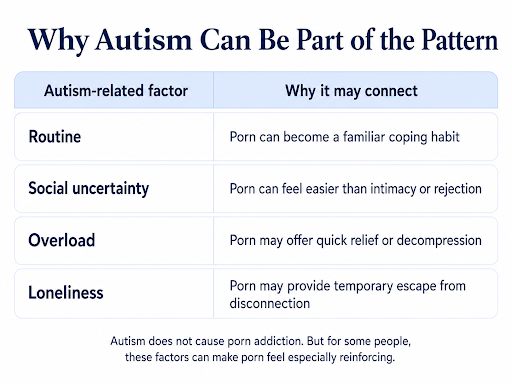
Porn and autism can be linked because porn offers:
Predictability when social life feels uncertain Many autistic people spend a lot of energy trying to understand unclear social rules, tone, body language, and expectations. Porn can feel simpler because it is familiar, repeatable, and does not require guessing what another person means.
Relief from the pressure to perform socially Dating and intimacy can involve flirting, timing, emotional risk, and fear of rejection. Porn removes those demands, which can make it feel safer in the short term.
A way to decompress after masking or overload After a day of sensory stress, social effort, or masking, the nervous system may look for fast relief. Porn may become one of the quickest ways to check out, calm down, or shift away from overwhelm.
Temporary escape from loneliness Some autistic people deeply want connection but find relationships confusing, painful, or hard to access. Porn can create a private escape from that loneliness, even if it does not provide real closeness.
A sense of control around sexuality Real intimacy involves another person’s needs, feelings, boundaries, and responses. Porn can feel more controllable because it happens privately and on the person’s terms.
The problem is not autism itself. The problem is when porn becomes the main way someone manages stress, loneliness, uncertainty, or emotional discomfort.
That does not mean autism causes porn addiction. Research on autism and problematic pornography use is still developing, so it is important not to overstate the connection. But for some autistic people, porn can become especially reinforcing.
What Porn May Be Doing Underneath
Porn use is usually the visible part of the problem. But underneath the behavior, there is often something more vulnerable happening.
For some autistic people, porn may become connected to sensory overload, anxiety, boredom, rejection pain, or confusion about sexuality and intimacy.
A helpful question is:
What is porn helping me avoid, regulate, or escape?
Once the underlying need is clearer, recovery can become more practical.
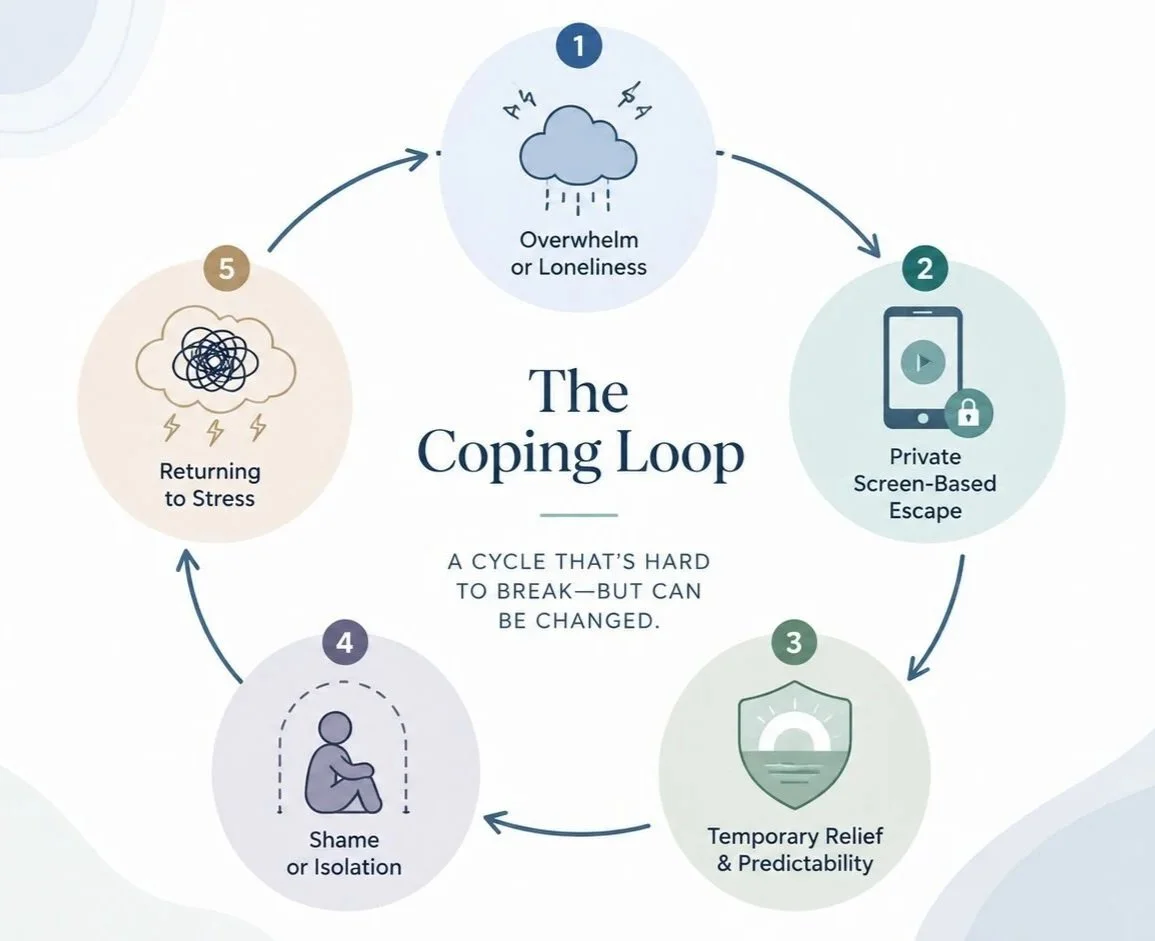
When Porn Use Becomes a Coping Loop
Porn use becomes more concerning when it starts to feel less like a choice and more like a pattern.
The issue is not only how often someone watches porn. Frequency can matter, but it is not the whole story. The deeper question is what porn is doing for the person.
When porn becomes the main way to regulate uncomfortable feelings, it can start to function like a coping loop.
Healthy Sexuality vs. Coping Loop
Healthy sexuality:
Fits your values, Chosen freely, Allows connection, Can be talked about honestly
Coping loop:
Feels hard to control, Creates shame, Increases secrecy, Used to escape distress
Some people use porn occasionally and do not experience it as compulsive, secretive, or distressing. Others may feel like porn has started to control them, even if they keep promising themselves they will stop.
For autistic people, this can become especially painful when the routine feels familiar but the aftermath feels shameful.
The person may not only feel frustrated that they watched porn again. They may feel confused by why the pattern keeps repeating, especially if they are trying hard to change.
Why Porn Can Feel Safer Than Relationships
Real intimacy can feel complicated. Porn removes many of those risks.
That can make porn feel safer than relationships, even when the person deeply wants real connection.
Porn can feel predictable.
Real intimacy can require uncertainty.Porn can feel private.
Real intimacy can require vulnerability.Porn can feel immediate.
Real intimacy can require patience.Porn can feel controlled.
Real intimacy can require communication.Porn can feel like there is no rejection.
Real intimacy can involve emotional risk.
If someone feels overwhelmed by social guessing, afraid of rejection, or unsure how to move toward intimacy, porn may become the easier path in the short term. But the easier path can also become the more isolating one.
Over time, a person may feel caught between two painful realities: wanting closeness, but returning to something private because closeness feels too uncertain.
When Autism and ADHD Both Play a Role
Some autistic people also have ADHD traits or an ADHD diagnosis.
When autism and ADHD overlap, the pattern may have two different forces. Autism may help explain why porn feels regulating or predictable. ADHD may help explain why it becomes harder to pause, shift away, or stop once the person is already engaged.
If ADHD symptoms are part of the pattern, ADHD therapy in Gainesville can help with structure, emotional regulation, impulsivity, and follow-through.
Someone may need better routines, but also better impulse barriers. They may need less shame, but also more structure around vulnerable times of day. They may need emotional regulation skills, but also support for loneliness, dating anxiety, or sensory overload.
When Porn Becomes Sex Education
Porn can also become a problem when it quietly becomes a person’s main source of sexual learning.
Research has also pointed to gaps in sexuality education for autistic adolescents, which can leave some people looking online for answers about sex, relationships, and intimacy.
Porn may show sex, but it usually does not show the quieter parts of intimacy: communication, pacing, mutual comfort, consent, repair, awkwardness, emotional safety, or care after vulnerability.
When porn becomes the default teacher
Porn often teaches performance.
Real intimacy requires communication.Porn often teaches instant access.
Real intimacy requires pacing.Porn often teaches unrealistic bodies.
Real intimacy requires mutual comfort.Porn often teaches one-sided scripts.
Real intimacy requires consent.Porn often teaches little emotional context.
Real intimacy requires emotional safety.
A healthier path includes clearer education, less shame, and more honest conversations about sexuality, consent, attraction, and emotional connection. That kind of learning can help someone move away from secrecy and toward a more grounded understanding of intimacy.
What Helps Break the Loop
Stopping porn is usually harder when the only plan is “try not to do it.”
That approach may work for a little while, but it often falls apart when the person is tired, lonely, anxious, overstimulated, or ashamed. If porn has become a coping tool, then recovery needs to address the reason the behavior keeps coming back.
A better question is:
What does porn do for me that I do not yet know how to get another way?
For many people, change also requires a practical plan. A guide on how to quit porn can be helpful when someone needs to understand triggers, routines, replacement coping tools, and what to do during vulnerable moments.
It can also help to understand the porn recovery timeline, especially when urges, emotional discomfort, or shame continue after someone starts making changes.
A More Compassionate Path Forward
If you are autistic and struggling with porn, it may mean your nervous system found a fast way to get relief, and that relief slowly became a pattern you no longer feel free inside of.
The first step is not more shame. It is understanding the loop clearly enough to interrupt it.
For some people, that means learning better ways to decompress after overload. For others, it means addressing loneliness, anxiety, ADHD symptoms, relationship fears, or confusion around sexuality and intimacy.
Therapy can help when porn use feels compulsive, secretive, or hard to control. It can also help when the pattern is tied to anxiety, shame, autism, ADHD, loneliness, or difficulty navigating relationships.
Frequently Asked Questions
Can autism cause porn addiction?
Autism does not cause porn addiction. But for some autistic people, porn may become a predictable way to manage stress, loneliness, sensory overload, anxiety, or uncertainty around dating and intimacy. The concern is not autism itself, but whether porn has become compulsive, secretive, or hard to control.
Can ADHD make porn harder to stop?
Yes, ADHD can sometimes make the pattern harder to interrupt. Impulsivity, novelty-seeking, time blindness, and difficulty stopping once engaged can all make porn use feel more automatic. This can be especially frustrating when someone genuinely wants to stop but keeps returning to the same routine.
When does porn use become a problem?
Porn use may be a problem when it feels hard to control, creates shame or secrecy, interferes with relationships, takes over time, or becomes the main way someone handles stress, boredom, loneliness, or emotional discomfort. The issue is not only frequency. It is whether porn has started to control the person more than the person controls it.
Looking for Support with Compulsive Porn Use?
Brooks Counseling and Wellness offers porn addiction therapy across Florida for adults who feel stuck in patterns of porn use, shame, secrecy, anxiety, or relationship stress.
Support is available if porn has started to feel less like a choice and more like a private loop you keep returning to.
Related Reading
A practical guide to understanding triggers, reducing access, and building healthier coping tools.
A helpful overview of what people may experience after they begin changing their porn use.
Explore Adult autism evaluations in Gainesville and across Florida.