How ADHD Therapy Works: Understanding What Gets in the Way

ADHD therapy is not just trying harder
If you have ADHD, you may already know what you “should” be doing.
You may know you need to start earlier, answer the email, stop scrolling, or follow the routine you made for yourself. The problem is often not that you lack information.
The harder question is: what happens inside you when it is time to do the thing?
That is usually where I focus in ADHD therapy. I am not only asking whether you procrastinate. I want to understand the moment before the procrastination.
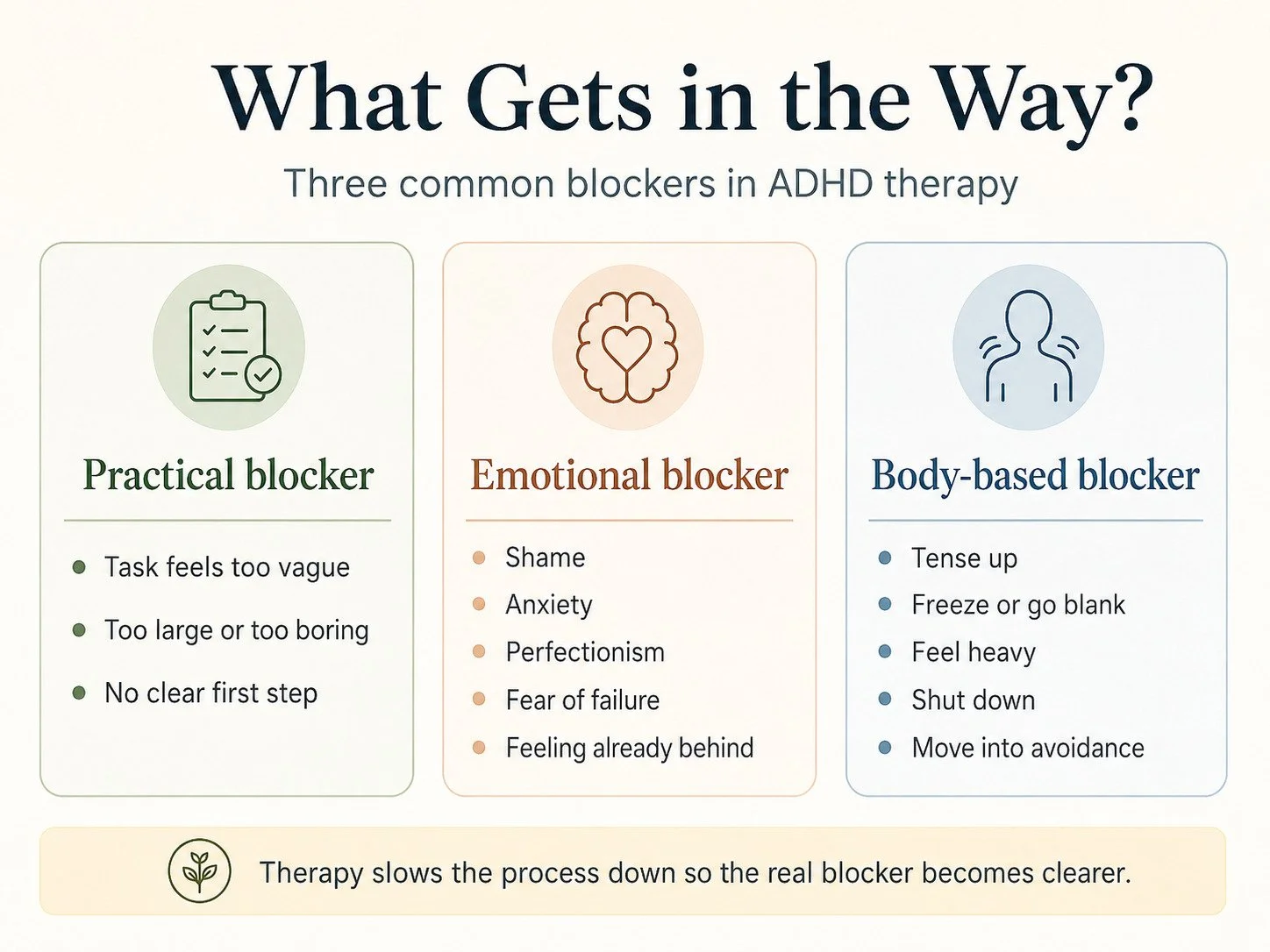
In that moment, I am often listening for three things:
The practical blocker: Is the task too vague, too large, too boring, or missing a clear first step?
The emotional blocker: Does the task bring up shame, anxiety, perfectionism, fear of failure, or the feeling that you are already behind?
The body-based blocker: Do you tense up, freeze, go blank, feel heavy, shut down, or move into avoidance before you even realize what happened?
Sometimes people avoid so quickly that they barely notice the discomfort. They only see the outcome: they scrolled, shut down, delayed, distracted themselves, or waited until the pressure became intense enough to act.
In therapy, we slow that process down. Not to overanalyze everything, but to understand the actual blocker. Once we know what is getting in the way, the work becomes more specific.
ADHD can affect more than attention
ADHD is often described as a problem with attention, but it can affect much more than focus. It can affect time, motivation, emotion, follow-through, organization, routines, and the ability to start tasks that feel boring, unclear, or overwhelming.
For many people, ADHD shows up in the gap between knowing what to do and being able to do it consistently.
While ADHD can be a useful framework for understanding why certain patterns keep repeating, therapy still looks at the whole person, including anxiety, depression, trauma, relationships, school, work, family stress, sleep, self-esteem, and the pressure someone has been carrying for years.
Finding the specific blocker
Two people can both say, “I procrastinate,” but the process underneath may be completely different.
One person may be stuck because the task is too vague. They do not know where to start, what order to do things in, or what counts as “done.”
Another person may be stuck because the task brings up shame. Starting the task feels like facing all the times they have fallen behind before.
This is why ADHD therapy is not usually as simple as “you have ADHD, so here is the ADHD solution.” In therapy, we try to understand the pattern before choosing the tool. That may include asking:
Where does the process break down? Is the hardest part starting, staying with it, switching tasks, finishing, remembering, organizing, or recovering after getting overwhelmed?
What happens inside? Do you feel anxious, bored, ashamed, frozen, restless, defeated, pressured, or disconnected?
What are you afraid might happen? Are you afraid of failing, being judged, feeling trapped, doing it wrong, disappointing someone, or proving something negative you already believe about yourself?
Those questions help us move from “I just need to stop procrastinating” to a clearer understanding of what actually needs attention.
When the blocker is practical
Sometimes the blocker really is practical. The task may be too large, too vague, too boring, or too far away from an obvious reward. There may be too many steps held in your head at once. In that case, therapy may focus on structure.
That could mean breaking the task into smaller parts, reducing friction, creating reminders, planning for transitions, or building routines that are realistic instead of idealized.
A lot of people with ADHD have already tried perfect systems. They work for a week, then life gets stressful, boring, or busy, and the system disappears.
Practical support matters, but it has to fit the person. This is also why ADHD task paralysis often needs more than another productivity tip.
When the blocker is emotional
Sometimes the task is not only difficult because of executive functioning. It is difficult because of what it brings up emotionally.
A paper may bring up fear of failure. A messy room may bring up shame. An unanswered email may bring up guilt. A job application may bring up rejection. A difficult conversation may bring up the feeling that you are going to disappoint someone.
If that emotional layer is strong enough, the brain may look for relief before you even realize what happened.
That relief might be scrolling, gaming, sleeping, overthinking, doing a less important task, or waiting until pressure becomes intense enough to force action.
In therapy, we may work with the belief or feeling underneath the avoidance. Sometimes that means challenging harsh self-criticism. Sometimes it means practicing imperfect action. Sometimes it means noticing the fear of failure and still taking one small step toward what matters.
This is where ADHD therapy may draw from CBT, ACT, DBT skills, or parts-informed work.
The exact approach depends on what is happening. If the issue is all-or-nothing thinking, we may work with thoughts. If the issue is avoidance of discomfort, we may work on values-based action. If the issue is emotional flooding, we may build regulation skills.
The work is learning how to relate differently to the feelings that show up when you try to move forward.
When the blocker is body-based
Sometimes the most important clue is in the body.
You may think about starting a task and feel tightness in your chest, heaviness in your body, restlessness, or a sudden urge to escape.
If you cannot feel anything in your body when we talk about the task, I see that as information too. It may mean your system moves into avoidance, numbness, or overwhelm so quickly that the discomfort is hard to notice.
For some people, ADHD therapy includes learning to notice these early signals.
What happens in your body when you open the assignment? What happens when you think about answering the text?
This kind of work can be especially helpful when someone keeps saying, “I don’t know why I didn’t do it.” Sometimes the answer is not obvious because the reaction happened before conscious thought.
Somatic work can help slow that down. Not by forcing someone to sit with overwhelming feelings for too long, but by making the moment more visible. The goal is to notice the discomfort early enough that there is more choice.
Action matters between sessions
Insight is important, but ADHD therapy usually cannot only be about insight. That is why I often want therapy to include small experiments between sessions.
Usually, the experiment needs to be small enough that it has a real chance of happening.
That might mean opening the assignment for five minutes, sending one uncomfortable email, moving the phone before starting work, practicing one grounding skill before a task, or choosing one value-based action that goes against an old belief.
These small steps matter because they create new evidence.
If part of you believes, “I never follow through,” then we need small moments of follow-through that are realistic enough to repeat.
If part of you believes, “I can’t handle discomfort,” then we need small doses of discomfort that you can stay with without immediately escaping.
This is where therapy becomes both practical and emotional. The action is not just about completing the task. It is also about changing your relationship with yourself over time.
How ADHD therapy is different from generic advice
Most people with ADHD have already heard plenty of advice.
Use a planner. Make a list. Try harder. Stop procrastinating. Put your phone away. Just start earlier.
Some of that advice may be technically true, but it usually skips the most important question:
Why is this so hard to do consistently?
That is what makes ADHD therapy more specific than general productivity advice. The question is not only, “What strategy should you use?” It is also, “What gets in the way of using that strategy when you need it most?”
The CDC also describes ADHD treatment as involving more than one possible kind of support, including behavioral approaches, medication options, and support across settings. You can read more about ADHD treatment options from the CDC.
Moving forward with ADHD therapy
ADHD therapy works best when it is specific to the person.
For some people, that means building better systems for tasks, time, and follow-through. For others, it means working with shame, anxiety, perfectionism, emotional overwhelm, trauma, or compulsive habits that make change harder.
Most of the time, it is a mix of both.
If you are interested in ADHD therapy in Gainesville or online ADHD counseling in Florida, you can learn more about working with me on my ADHD therapy page.