ADHD and Social Anxiety: Why Social Life Can Feel So Hard

ADHD and social anxiety can overlap in ways that are easy to miss.
For adults with ADHD, social anxiety may come from years of feeling misunderstood, corrected, or out of sync with other people.
A few patterns can make the connection stronger:
ADHD can create social friction. Someone may interrupt, zone out, or talk more than they meant to. Even when these moments are not intentional, they can become embarrassing over time.
Social anxiety can build around those bad experiences. After enough awkward moments, the person may start expecting rejection before anything has happened.
The anxiety can continue after the interaction ends. Many adults with ADHD replay conversations afterward, searching for signs that they said too much or came across wrong.
A 2024 review found that the relationship between ADHD and social anxiety is real but complicated. That matters clinically because the same outward anxiety may have different causes underneath.
When I work with adults in ADHD therapy, I am usually listening for the pattern underneath the anxiety. Is this mostly fear of judgment or is ADHD making conversations harder to manage? Often, it is more than one thing.
How ADHD Can Create Social Friction
ADHD can affect social situations in ways that are easy to miss. Often because conversations have too many different forms of stimulation at the same time.
A client may come in saying they are anxious in groups. But when we slow it down, the anxiety is not only about being judged. They are trying to follow the conversation, decide when to speak, and notice whether the other person’s energy has shifted.
That is a lot to manage at once.
The anxiety may make more sense when you realize the person is trying to manage attention, impulse control, and self-presentation at the same time.
When One Social Moment Carries Years of History
For some adults with ADHD, the painful part of social anxiety is that the present moment does not feel isolated. Years of being corrected, misunderstood, or rejected can build up in the background.
A small awkward pause, a joke that does not land, or the feeling that someone’s tone shifted may touch a much older network of memories.
The person may know logically that the interaction was probably fine. But emotionally, the body may be responding to an older pattern:
“This is happening again.”
This is why the reaction and anxiety can feel bigger than the situation seems to justify.
For someone with ADHD and layers of social shame, the moment may land differently. It can feel like one more piece of evidence in a story that has been building for years.
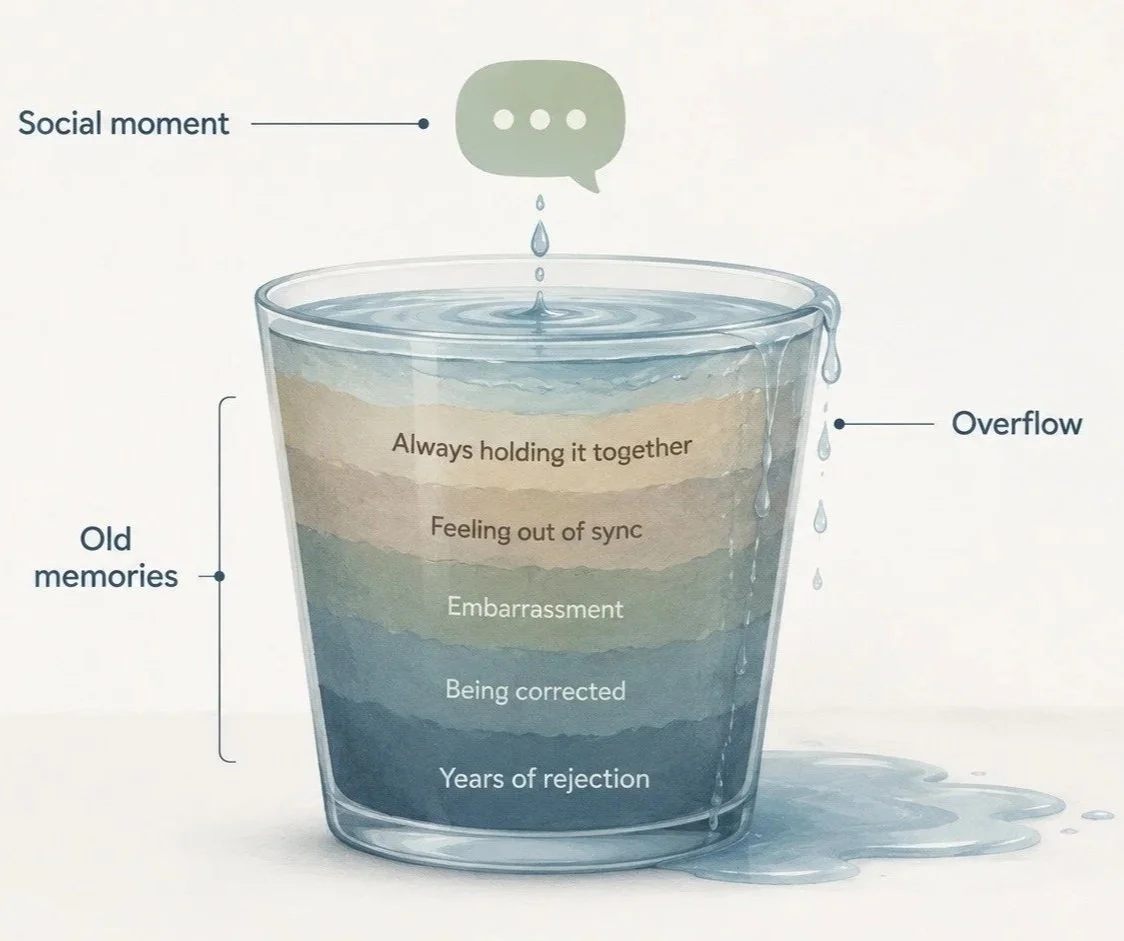
A person already at capacity
I often think of this like a cup that is already close to full. A small social miscue may not seem like a big deal from the outside. But if the person already carries years of rejection or correction, that small moment can be the thing that makes the cup overflow.
In therapy, this is often where it helps to slow the experience down and work specifically with these memories from the past. We are not only asking whether the social fear is realistic. We are also asking what memory or part got activated by the moment.
That gives the person more to work with than simply telling themselves to stop overthinking.
The After-Social-Event Loop
Many adults with ADHD and social anxiety do not only feel anxious before a social situation, they may also spiral afterward:
Replaying what they said: They may go over certain lines again and again, trying to decide whether they sounded awkward or said too much.
Scanning for signs of rejection: They may look back for changes in tone, facial expression, or energy that might mean someone was annoyed.
Trying to solve the interaction afterward: Even though the conversation is over, the mind keeps working as if more analysis will finally make the person feel certain.
A little reflection can be useful. It can help someone notice a pattern or repair something if needed.
But the loop becomes less useful when the person is no longer learning anything new. They are just trying to get certainty that they were not rejected.
Noticing the loop
Instead of answering every anxious thought, it can help to name what is happening:
“I am replaying this because I feel uncertain.”
That kind of noticing does not make the anxiety disappear immediately. But it creates a little space between the person and the loop.
Depending on the situation, this noticing of the thought loop alone can sometimes make it go away.
In therapy, I often want to help the person notice when they have moved from useful reflection into repeated review. At that point, more thinking may not bring more clarity. It may just keep the nervous system activated.
The Conflicting Parts Underneath Social Anxiety
A parts-work lens can be very helpful with ADHD and social anxiety.
Often, the person does not only have one feeling. For example, a socially anxious person may have multiple conflicting parts.
One part wants connection.
One part is afraid of embarrassment.
One part criticizes the anxious part for being so sensitive.
This internal conflict can make social anxiety harder to resolve.
A person may have a socially anxious part that is trying to protect them from rejection. But another part may hate that anxiety and say:
“Why are you like this? Just act normal.”
When that happens, the anxious part does not usually become calmer. It often becomes louder.
Understanding your different parts
From my perspective, the problem is not only the social anxiety, it is also the person’s relationship to the anxiety.
If the anxious part is treated like an enemy, the person ends up fighting with themselves. One part feels afraid, another part attacks the fear, and nothing really gets resolved.
In therapy, the first step is often understanding what the anxious part is trying to protect.
What is it afraid would happen if it did not worry?
What memories does it carry?
This can be especially important for adults with ADHD who have spent years feeling frustrated with their own reactions. The anxiety may be painful, but the inner criticism toward the anxiety can become its own source of suffering.
Once these parts are better understood and cared for, the whole system can become more at peace.
How Therapy Can Help When ADHD and Social Anxiety Overlap
When ADHD and social anxiety overlap, therapy is not only about becoming more confident socially. It is about understanding what is driving the anxiety.
Different parts of the pattern may need different kinds of support.
When ADHD is part of the social difficulty
If ADHD is contributing to the anxiety, therapy may include practical work around attention, pacing, and repair.
That might include noticing when someone starts overexplaining, practicing ways to pause in conversation, or learning how to repair after interrupting.
This is not about becoming perfectly polished socially. It is about helping the person understand their patterns so social life does not feel like a constant performance review.
When older memories are getting activated
If current social anxiety is tied to memories of rejection, humiliation, or feeling misunderstood, the work may need to go deeper than social skills.
This is where trauma-informed approaches, including EMDR, may be helpful.
The focus is not on convincing someone that nothing bad ever happened. It is helping the nervous system process older material so the present moment does not carry as much emotional weight.
When parts are in conflict
If one part wants connection and another part wants to hide, parts work can help the person understand the conflict instead of getting stuck inside it.
The anxious part may need to be heard. The critical part may need to soften. The avoidant part may need reassurance that the person will not be pushed too far too fast.
This can help the person approach social situations with more internal steadiness.
When anxiety is maintaining avoidance
If avoidance has become a major part of the pattern, anxiety therapy in Gainesville may include a flexible social hierarchy, gradual exposure, and learning how to tolerate uncertainty without replaying every interaction afterward.
For adults with ADHD, it may also need to include structure, recovery time, and attention to stimulation level.
ADHD and Social Anxiety Can Both Be True
For many adults, social anxiety develops through a mixture of ADHD-related social friction, old memories, and internal criticism.
Understanding those layers matters because the right support depends on what is actually happening underneath. Once we have a better understanding of the pattern, a person can grow to become more confident and less anxious over time.
Further Reading
Living With Adult ADHD: How Shame Builds Over Time
A closer look at how ADHD can become tied to shame over time, especially when years of misunderstood struggle start to feel like a character flaw.
ADHD Task Paralysis and the Body
A body-based look at why starting can feel physically hard with ADHD, especially when a task brings up pressure or shutdown.